
From dating apps and situationships to handwritten love letters and arranged introductions—what global dating trends reveal about modern love
8–10 minute read | Global dating trends | 2025–2026 research
The dating world has changed. But has love?
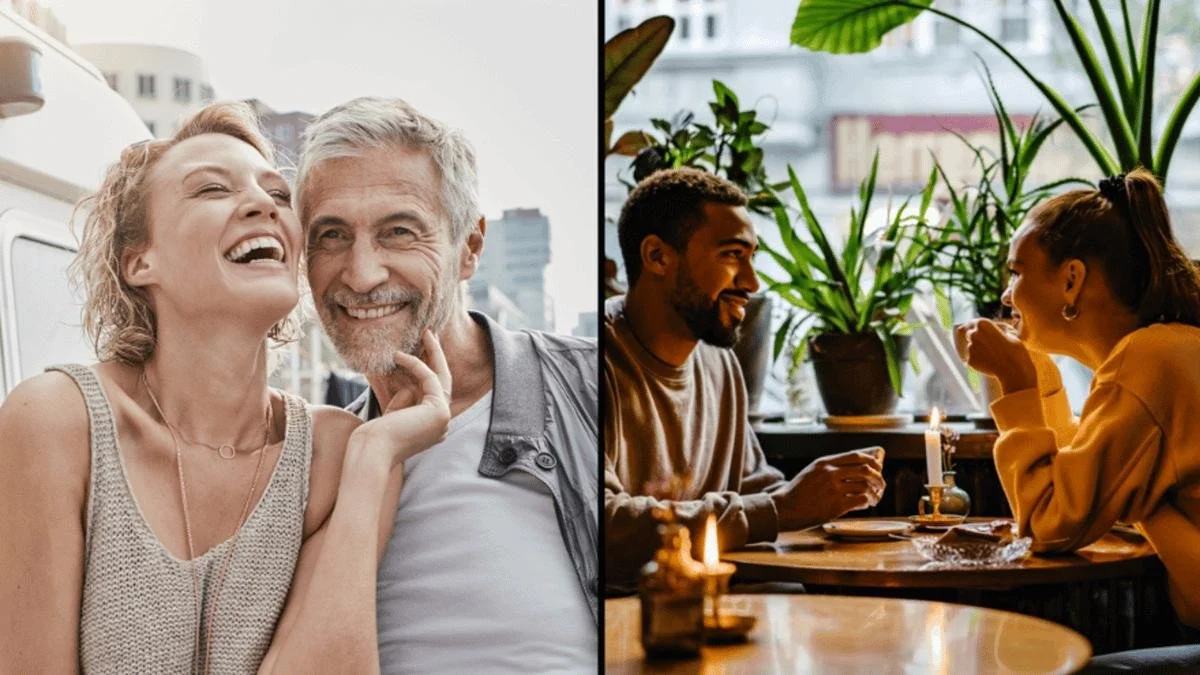
Imagine two people sitting at a café.
One is 25. She's wondering why someone who sent her 17 heart emojis yesterday hasn't replied today.
The other is 55. She's wondering whether the charming gentleman she met through friends is genuinely interested—or simply very polite.
Different generations. Different dating dilemmas. Same question:
“Does this person actually like me?”
Welcome to dating in 2026, where Gen Z has situationships, Gen X has relationship experience, and everyone has a story about someone who stopped communicating.
But beyond the memes and dating disasters, what does the research tell us?
1. The numbers: Gen Z versus Gen X
According to the 2026 SSRS survey of U.S. adults, online dating is widespread among younger people but far from universal
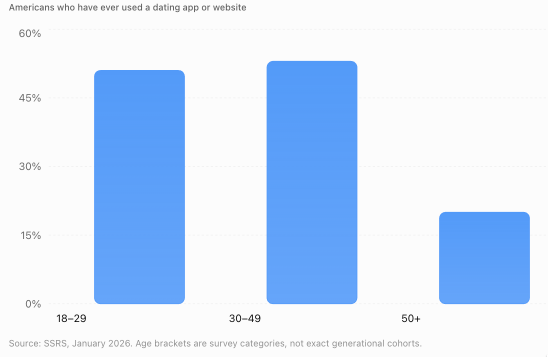
GenZ vs GenX statistics
These numbers reveal something interesting: online dating isn't exclusively a Gen Z activity. People in their 30s and 40s are just as likely to have tried it. And half of Americans who have ever used a dating app or website say they've had a committed relationship with someone they met there.
MYBiiDOO takeaway:
Technology can introduce two people. But technology alone cannot create trust, emotional maturity, or long-term compatibility.
2. Gen Z: The generation that wants love but questions the process
Gen Z is often portrayed as the generation of casual dating, ghosting, and situationships. But the data tells a more hopeful story.
Research published by Match Group in June 2026 found:
80%
of Gen Z respondents believe they will find true love.
62%
feel more comfortable flirting online than in person.
In other words, young people haven't necessarily stopped believing in romance. They may simply be more comfortable beginning it behind a screen. Gen Z has introduced an entirely new relationship vocabulary: breadcrumbing, orbiting, soft launching, situationships, and the talking stage. Gen X might reasonably ask: “Are we dating, or are we launching a software product? “ But beneath the funny terminology is a serious desire for clarity.
Bumble's global research for its 2025 dating trends found that nearly 3 in 4 surveyed Bumble members were seeking a long-term partner in the coming year. This was a platform-member survey, not a representative survey of all singles. Perhaps Gen Z isn't afraid of commitment. Perhaps they're afraid of committing to the wrong person.
3. Gen X: Less swiping, more life experience
Gen X grew up when meeting someone often meant introductions through friends, workplaces, colleges, family gatherings, or chance encounters. There was no checking someone's online status every five minutes. If someone didn't call, you waited. And sometimes, you actually had to call their home and risk having their father answer the phone! Today, Gen X daters may be returning to dating after divorce, separation, or the loss of a partner. Others may be looking for meaningful companionship for the first time in years.
For this generation, compatibility can involve different questions:
Do we share similar values and lifestyles?
Can we respect each other's independence?
How do we navigate children, family responsibilities, or financial commitments?
Can we enjoy companionship without unnecessary drama?
These are not universal Gen X preferences. They're useful considerations for people dating in a later life stage. The interesting contrast: Gen Z may be learning what healthy relationships look like. Gen X may be discovering that knowing what doesn't work is equally valuable. And both generations can benefit from intentional dating.
4. Around the world: Who's happiest in love?
Love may be universal, but relationship satisfaction varies considerably across countries. The 2025 Ipsos Love Life Satisfaction Index surveyed people in 30 countries, measuring satisfaction with love, romantic life, and relationships.
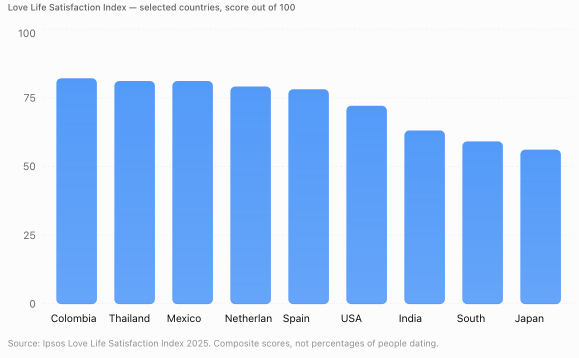
Love Life Satisfaction Index — selected countries, score out of 100
What can we learn from these numbers?
Latin America: Love is alive and well
Mexico and Chile recorded 86% of respondents saying they felt loved, with Colombia close behind at 85%. Perhaps there's something to be said for expressing affection openly, nurturing social connections, and making time for relationships. But the survey doesn't establish which cultural behaviors caused these results.
Europe: Relationship satisfaction has different shades
The Netherlands and Spain were among the top ten countries on the overall index.
In the Netherlands, 92% of people in relationships reported satisfaction with their partner. That's an encouraging reminder that meaningful relationships are very much possible.
Asia: Different pressures, familiar emotions
Japan and South Korea ranked lowest among the 30 countries on the composite index. India also scored below the surveyed-country average.
These results raise interesting questions about work-life balance, social expectations, emotional connection, and changing attitudes toward relationships. They do not, by themselves, tell us why satisfaction differs. The MYBiiDOO perspective: A person's country or culture can shape their dating experience, but it should never be used to predict how loving, committed, or compatible that individual will be.
5. The biggest surprise: Values may matter more than salary
Here's a statistic that deserves attention. The 2026 SSRS study asked Americans who had ever used dating apps what mattered most when matching with someone. nly 9% said earning as much money as they do was very important.
That doesn't mean financial security is irrelevant. It means equal earnings ranked much lower than shared family values in this particular survey. And that raises a thought-provoking question: Are we sometimes filtering people by the easiest things to measure, instead of the things that matter most in a relationship? Height is measurable. Salary is measurable. Age is measurable. But kindness? Emotional availability? Integrity? The ability to apologize after an argument? Those qualities require conversation, observation, and time.
6. Romance is getting smaller—and perhaps more meaningful
Forget the helicopter proposal and the thousand roses. Sometimes romance is remembering how someone takes their coffee. Bumble's 2025 research found that 88% of surveyed U.S. women agreed that modern affection includes small gestures, such as sharing memes, playlists, or inside jokes.

Think about it.
A Gen X romantic gesture might have been recording a favorite song onto a cassette. A Gen Z romantic gesture might be creating a Spotify playlist. Different technology. Same message:
“I was thinking about you.”
The most meaningful expressions of love aren't necessarily expensive. They're personal.
7. So, who's better at dating—Gen Z or Gen X?
Perhaps neither.
Gen Z brings fresh perspectives on boundaries, identity, communication, and relationship expectations. Gen X brings life experience, resilience, and often a clearer understanding of personal priorities. Both can learn from each other. Gen Z can learn from Gen X. Gen X can learn from Gen Z. Give relationships time to develop. Communicate expectations earlier. Don't mistake instant chemistry for compatibility. Be open to new ways of meeting. Have difficult conversations offline. Recognize unhealthy relationship patterns. Understand that imperfections are normal. Don't settle merely because of social expectations. These are suggestions, not fixed characteristics of either generation.. And there's one lesson that transcends age:. A healthy relationship isn't about finding someone who agrees with you 100% of the time. It's about finding someone who respects you even when they disagree.
8. The MYBiiDOO approach: Less endless searching, more meaningful connection
Imagine spending months swiping through hundreds of profiles. You finally meet someone who looks perfect on paper. Same education. Similar career. Compatible age. Attractive photographs. But during dinner, you discover you have completely different ideas about commitment, family, communication, and the future. Now imagine starting with those deeper conversations. That's the philosophy behind MYBiiDOO. We believe meaningful matchmaking begins with understanding the person, not simply comparing profiles. Whether you're a Gen Z professional navigating dating apps or a Gen X individual rediscovering companionship, our relationship-first approach emphasizes understanding values, lifestyle, aspirations, cultural background, and emotional compatibility. Because a successful introduction isn't the finish line. It's the beginning of discovering whether two people can build something meaningful together.
Final thought: Love hasn't changed as much as dating has
The world has moved from handwritten letters to instant messages, from family introductions to dating algorithms, and from long phone calls to video dates.
Yet the fundamental questions remain:
Will you respect me? Will you understand me? Can I be myself around you? Will we choose each other when life becomes difficult?
Perhaps the future of dating isn't about having more options. Perhaps it's about making more intentional choices. And whether you're 25 or 55, it's never too early—or too late—to seek a relationship built on genuine understanding. MYBiiDOO — Meaningful Connections. Intentional Relationships. Interested in exploring a more personalized approach to matchmaking?
Visit MYBiiDOO's intake page and begin the conversation.
Sources and research notes
The statistics above come from published research, not MYBiiDOO's own client data. The global Ipsos survey covers the general population rather than only singles, while the Bumble research covers platform members. U.S. age brackets are not exact generational cohorts.